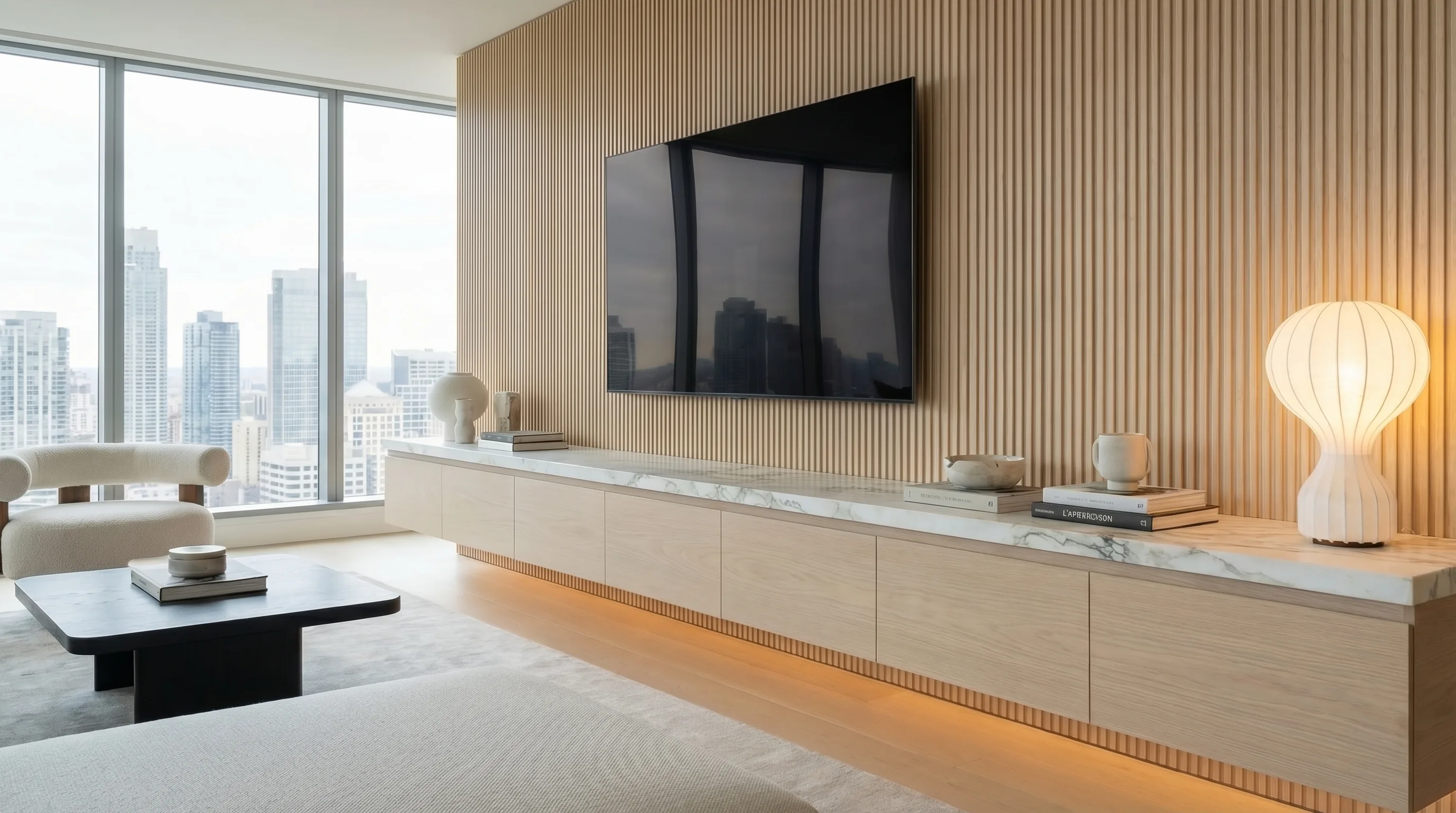
A media wall is a fitted joinery installation built around your television. It is not a bracket on a plasterboard wall. It is a bespoke carpentry build, designed to your room dimensions, your screen size and your AV setup, that conceals all cabling, houses your equipment and typically integrates storage, lighting and sometimes a fireplace.
What Does a Media Wall Include?
The exact specification varies by project, but a typical media wall installation includes some combination of the following:
- A structural timber or MDF frame built into or against the wall
- A television recess or mounting point sized to your screen
- Fully concealed cabling for power, HDMI, ethernet and aerial
- AV equipment housing, typically in a ventilated cabinet below or beside the TV
- Integrated LED lighting, usually behind the screen and within cabinetry
- Storage: closed cabinets, open shelving or a combination of both
- A fireplace: electric, bio-ethanol or gas, where specified
Why Build a Media Wall Rather Than Mount the TV?
Mounting a television on a wall is straightforward. A media wall is a different proposition, and it solves a different set of problems.
The first is cabling. A 75" television on a bracket still has a power cable, an HDMI cable, an aerial and often a soundbar cable trailing down the wall or bundled into a trunking cover. A media wall conceals all of it inside the structure. Nothing is visible.
The second is storage. Most living rooms have too much AV equipment and not enough places to put it. A media wall with well-designed cabinetry solves both problems simultaneously. The third is aesthetic. A considered media wall, proportioned to the room and finished in a material that relates to the rest of the interior, reads as a piece of furniture rather than an appliance on a wall.
What Size TV Works Best in a Media Wall?
The screen size that works best depends on viewing distance and wall width. As a rough guide: a 55" television works well at a viewing distance of 2 to 2.5m. A 65" suits 2.5 to 3m. A 75" reads well at 3m and beyond.
The wall width matters too. A 75" screen is 167cm wide. Ideally your wall is at least 100cm wider on each side to give the frame and cabinetry room to breathe. That means a media wall with a 75" television works best on a wall that is at least 3.5m wide. On a narrower wall, a 65" or 55" will read better.
How Much Does a Media Wall Cost?
A bespoke media wall installation starts from around £7,000 with AV integration and concealed cabling in a painted finish. Most projects fall between £10,000 and £18,000 depending on size, joinery complexity and finish.
A full-width floor-to-ceiling build with integrated lighting, bespoke cabinetry and an electric fireplace typically ranges from £14,000 to £22,000. Premium finishes such as stone, high gloss lacquer and book-matched veneer sit at the upper end of that range. All our projects are quoted with a fixed price after a complimentary consultation.
How Long Does Installation Take?
An installation takes around 10 days from the day we arrive on site. The plaster is what sets that: the stud work is built out and plastered first, and it needs two to three days to dry before anything goes on top of it. The cabinetry is built and painted in our warehouse while that is happening, so the two run in parallel rather than one after the other. We confirm the programme as part of your quote and stick to it.
Is a Media Wall Right for Your Home?
A media wall works in most living rooms, and in many bedrooms, open-plan kitchen-diners and home cinemas. The main requirements are: a wall long enough to accommodate the screen and frame with breathing room on each side, access for electrical work, and a ceiling height that gives the build good proportion.
The best way to know whether it works for your space is a design consultation. We visit, take measurements and discuss what is achievable within your room before you commit to anything.
Common questions
A media wall is a fitted joinery installation built into or against a wall of your home, designed to house a television, conceal all AV cabling, and typically include storage cabinetry, integrated lighting and sometimes a fireplace. Unlike a TV on a bracket, a media wall is a bespoke build made to the dimensions of your room.
A bespoke media wall installation starts from around £7,000 with AV integration and concealed cabling in a painted finish. Most projects fall between £10,000 and £18,000 depending on size, joinery complexity and finish. A full-width floor-to-ceiling build with integrated lighting, bespoke cabinetry and an electric fireplace typically ranges from £14,000 to £22,000. Every project is quoted at a fixed price after a complimentary consultation.
A media wall installation takes around 10 days from the day we arrive on site. The plaster sets that timeline: the stud work is built out and plastered first, and it needs two to three days to dry before the cabinetry can go on top of it. The cabinets are built and painted in our warehouse while that drying is happening, so the two stages run in parallel.