By Daniel at LV Carpentry & Tradesmen
Most small rooms are not too small for a media wall. They are too small for the wrong media wall. The constraint is not the room. It is the design brief. A full-width 3.5m floor-to-ceiling installation with a 75" screen and flanking floor-to-ceiling cabinetry belongs in a large reception room. In a smaller space, different solutions exist. They are often better suited to how the room actually gets used.
The Viewing Distance Problem
In a room under 4m deep, a 75" screen creates an uncomfortable viewing angle. This is the most common mistake in small room media wall planning. The TV choice is made first, the wall is designed around it, and the result is a screen that dominates the room and strains to watch from any seat close to it.
The rule of thumb is straightforward: screen width should be approximately one third of viewing distance. A 65" screen is 144cm wide, which requires a minimum viewing distance of roughly 2.4m. A 75" screen is 167cm wide and needs closer to 2.7m. In a room where the sofa sits 3m from the wall, a 65" is the ceiling, not the floor, for screen size.
This matters because the TV choice limits the wall design. A 65" recess is 30cm narrower than a 75" recess. In a small room, those 30cm give the flanking cabinetry room to breathe. We confirm viewing distance at consultation before any design work begins.
Alcove Builds: The Natural Fit for Small Rooms
Many small rooms have a chimney breast with flanking alcoves. This is the most natural architecture for a small media wall. The TV recess sits within the chimney breast face, and cabinetry fills the alcoves either side. No stud frame projects into the room. The build uses what is already there.
A typical alcove build works well when each flanking recess is at least 500mm wide and 300mm deep. The depth is the critical dimension. AV equipment needs room behind closed doors: a Sky box, amplifier and streaming device sitting in a ventilated cabinet require at least 250mm clear depth, plus the cabinet door thickness. Shallower alcoves can work with open shelving or shallow closed cabinets for decorative storage only.
Where the chimney breast projects significantly into the room, the TV recess can be recessed into the breast itself rather than surface-mounted. This reduces the depth the unit adds to the room and keeps the overall installation compact. It also means the television sits within the wall rather than proud of it, which reads as more considered in a tight space.
Corner Media Walls in Small Rooms
A corner build often works better than a flat wall in a room where no single wall is wide enough. Two shorter faces of an L-shape can combine to give the total width needed. In a room 3.5m wide with a 2.8m back wall, neither dimension alone accommodates a full media wall with comfortable proportions. An L-shape corner build resolves this.
The key is the sightline. The television position on the primary face must be checked from the sofa before the design is fixed. A corner build that positions the screen at 45 degrees works poorly from most seat positions. The screen should be on the dominant face with the secondary face used for cabinetry and storage. We model this at consultation stage. For more detail on how corner builds are designed and priced, see our corner media wall page.
Media Walls Under the Stairs
The space under a staircase is the most underused wall in most homes, and it takes a media wall well. It will never be symmetrical, because the stair runs down at an angle and one side always sits lower than the other. That is the character of it rather than a fault. The rake is exactly what lets you fit triangular shelving that follows the line of the stairs, with the TV central and open shelving to the sides.
Because people tend to keep shoes, wine or everyday bits under the stairs anyway, the build is designed to keep that function: a shoe drawer at the base, closed cabinetry, or open shelving with warm LED lighting so it still reads light in a tight space. Every staircase is different, so this is one build you cannot copy off a website. For how these are designed, priced and scribed to your staircase, see our media wall under the stairs page.
Finishes That Help a Small Media Wall
Finish choice has a measurable effect on how dominant a small media wall feels. The wrong finish makes a room feel smaller. The right finish makes the wall feel considered rather than cramped.
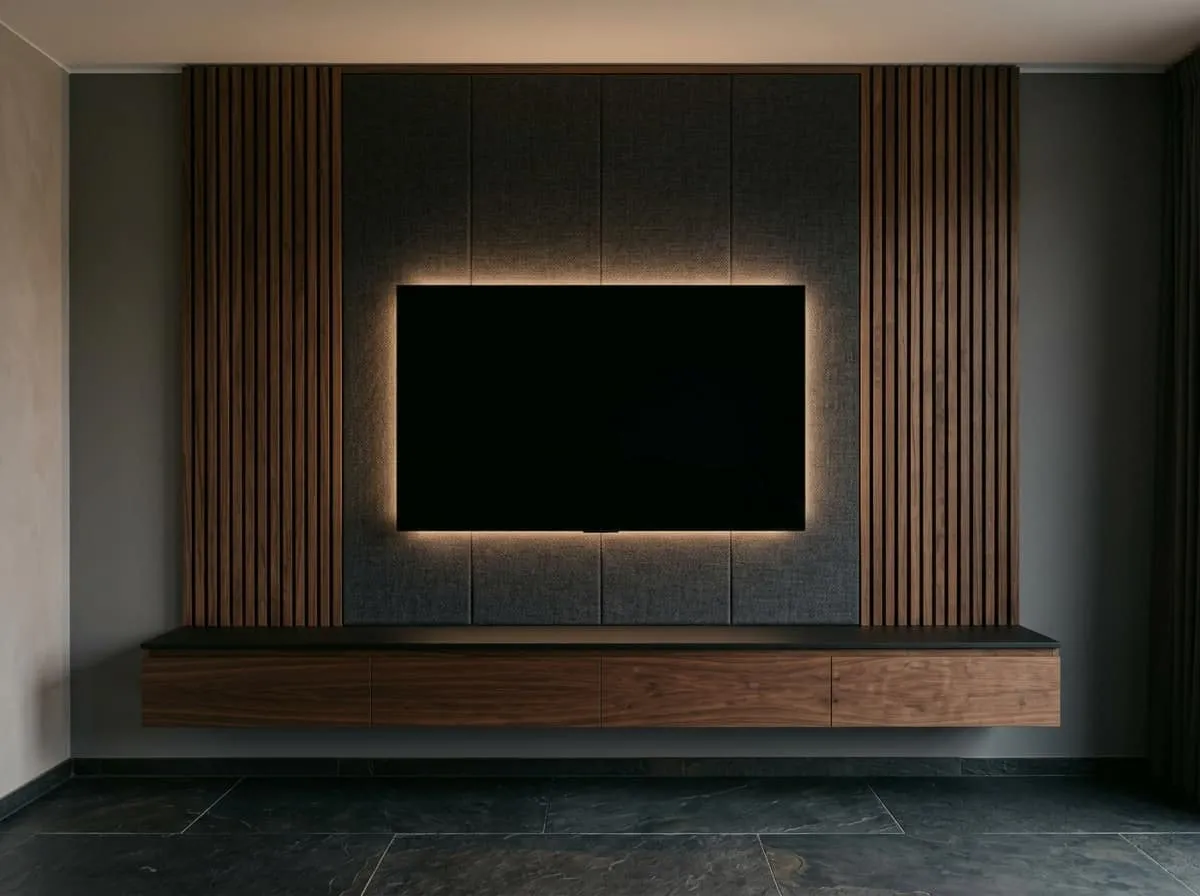
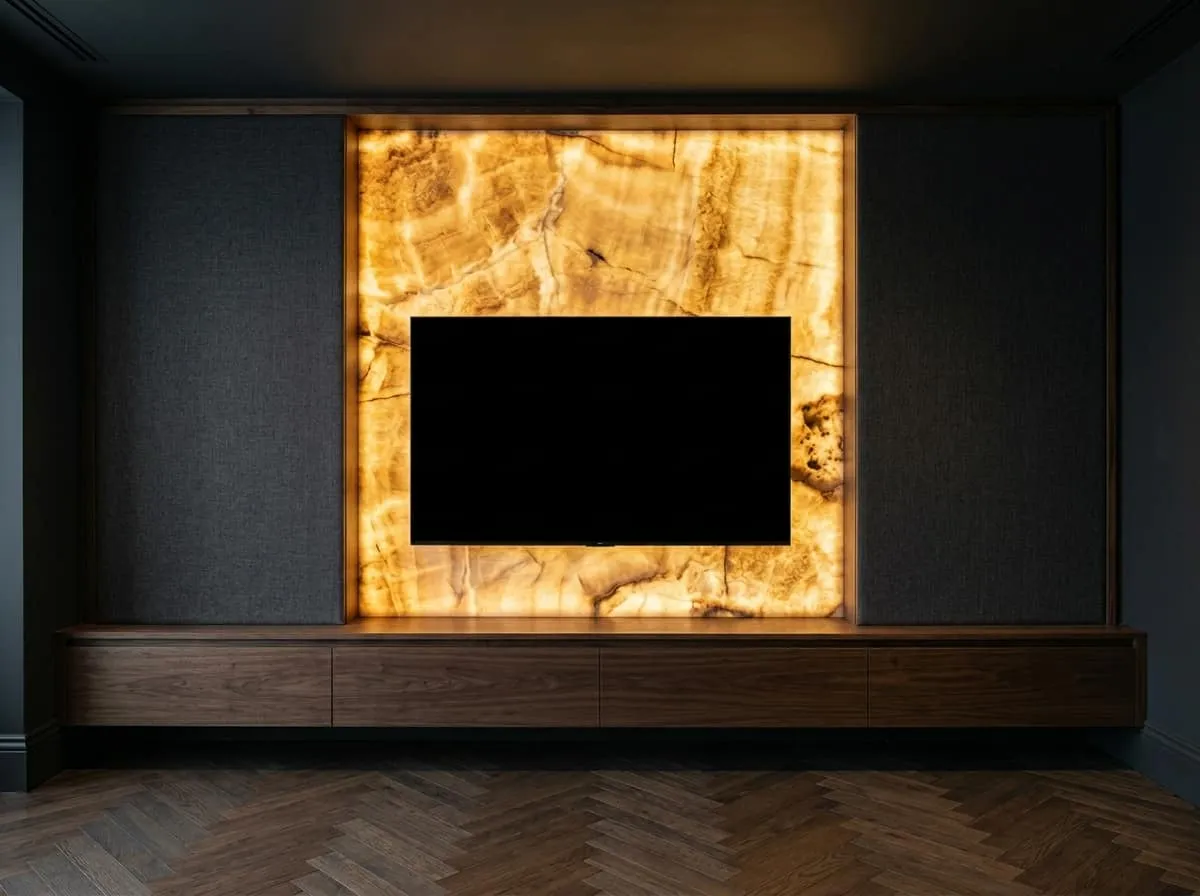
- Timber tone. Pale oak and natural ash are the most forgiving finishes in a small room. Dark walnut or stained timber can work, but only when the rest of the room is light. A dark wall in a small dark room creates a tunnel effect. If a client wants a darker finish in a compact space, we typically recommend it on the TV face only, with pale cabinetry flanking.
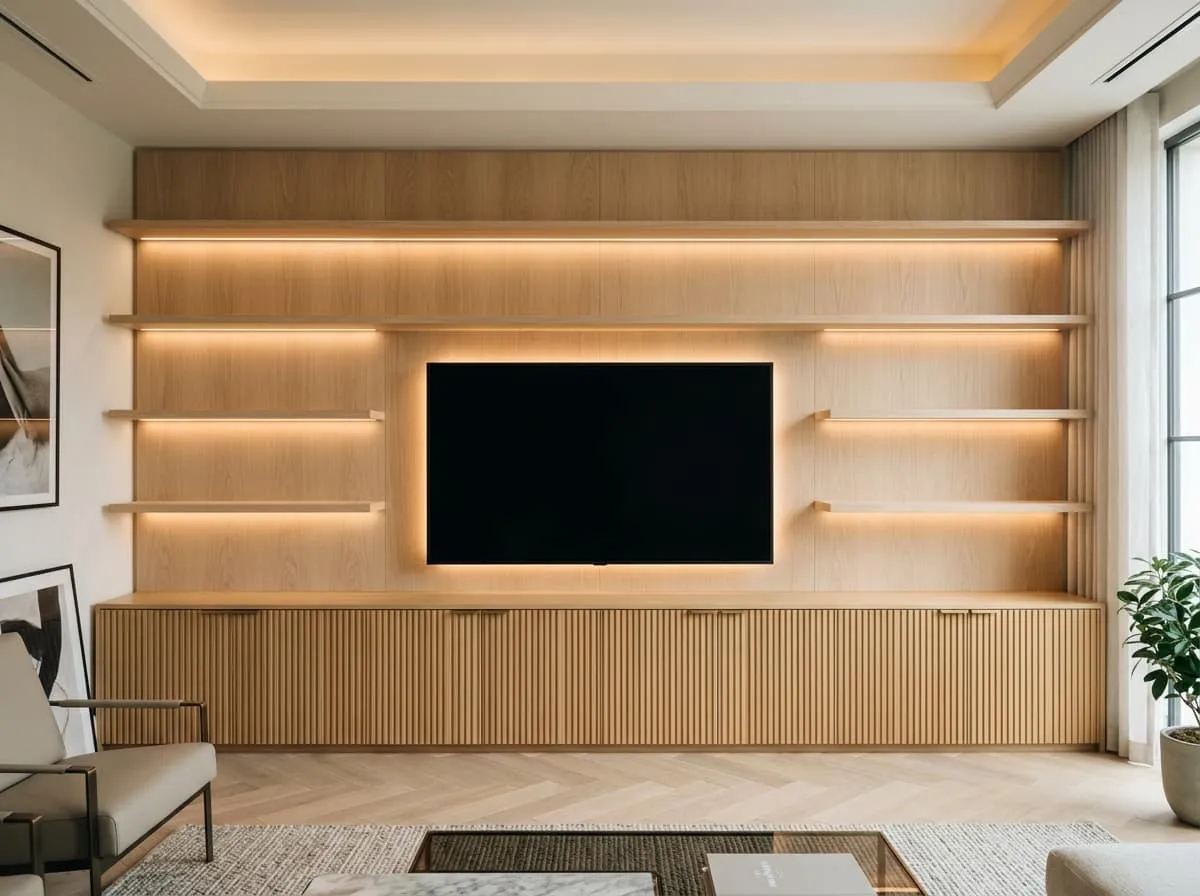
- Vertical lines, not horizontal. Vertical fluted panels draw the eye upward and create the impression of height. Horizontal shelf runs emphasise the width of the wall. In a room with a low ceiling (anything under 2.5m), horizontal emphasis makes the ceiling feel lower. Fluted oak or Shaker-style vertical uprights are the more flattering direction.
- LED lighting at 2700K. Warm white LED strip lighting at 2700K adds depth to a small media wall without making it feel clinical. Cornice-level backlighting or under-shelf strips soften the visual weight of the installation. Cool white at 4000K or above reads harshly in a domestic room and makes a compact wall feel smaller and more institutional.
- Avoid high gloss in narrow rooms. High-gloss lacquer reflects the room back at you. In a wide room with good natural light, this is an asset. In a narrow room, it amplifies the sense of enclosure. Satin or eggshell lacquer finishes in warm neutrals read better in tight spaces while still giving a considered, elevated result.
What to Skip in a Small Room
Several small media wall ideas that photograph well in large rooms do not translate to tighter spaces. These are worth naming directly.
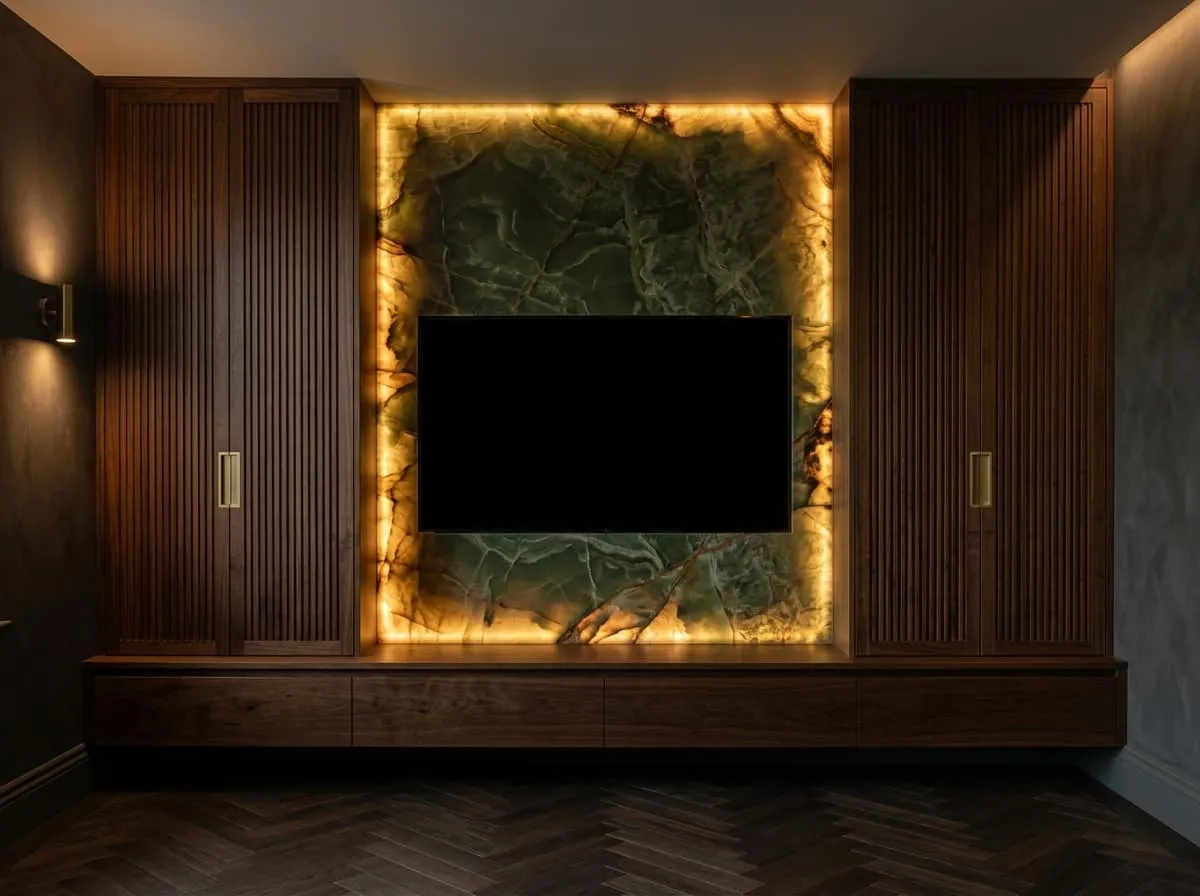
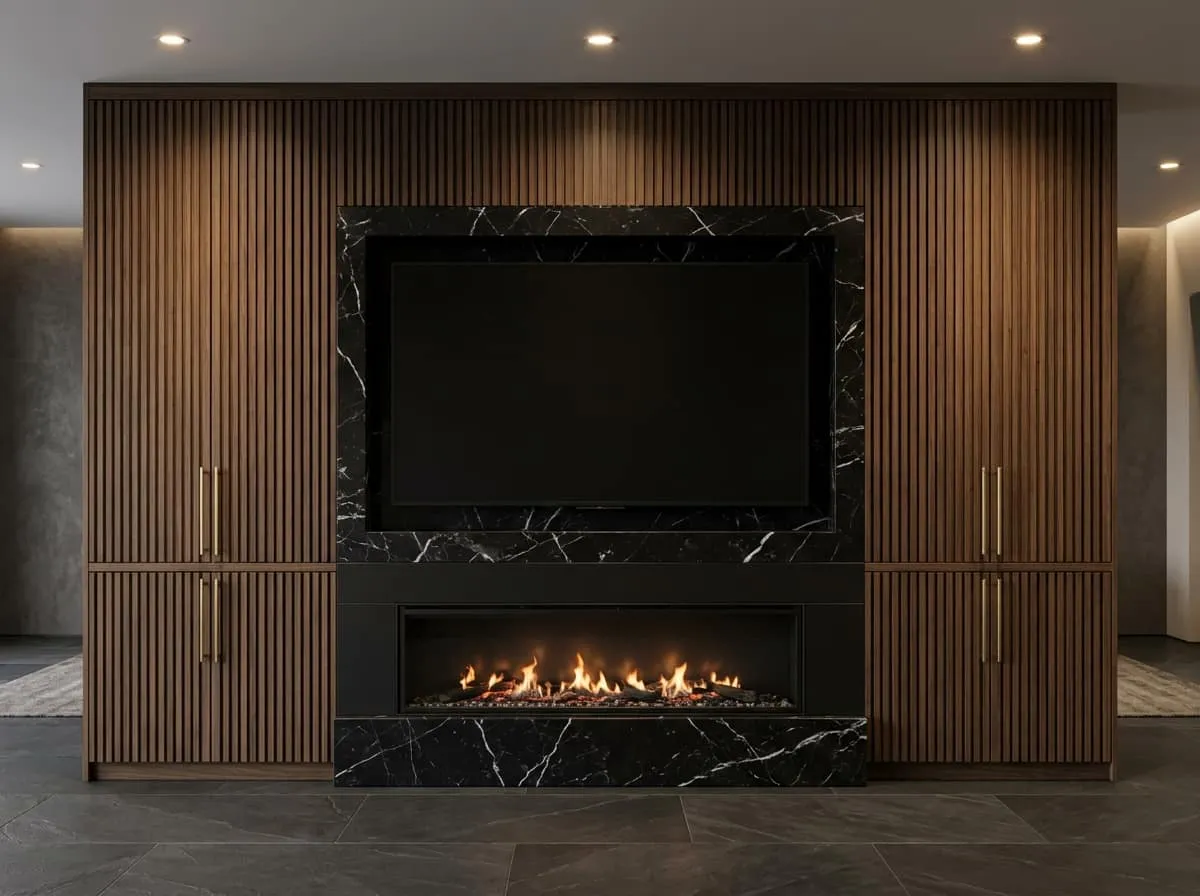
- A full-width floor-to-ceiling fireplace on a short wall. In a room under 4m wide, a fireplace below the TV on a short wall leaves almost no cabinetry. The fireplace aperture, the TV recess above it and the clearance between them consume most of the wall width. The result looks crowded. In this configuration, a corner build or an alcove build without a fireplace serves the room better.
- Deep open shelving at eye level. Open shelves at 400mm depth at eye level in a small room collect visual clutter and reduce the wall to a storage wall rather than a considered installation. In a compact space, 300mm is the maximum depth for open shelving. Below that depth, shelving reads as a display surface rather than a projection into the room.
- Matching dark cabinetry on multiple walls. A dark media wall on one wall is a strong design move. The same dark finish on an adjacent fitted bookcase or wardrobe creates a closed-in feeling. In small rooms, the media wall should be the single feature wall. Adjacent joinery, if any, should be a contrasting or lighter tone.
Half Media Walls and Floating Shelf Builds
For rooms where a full floor-to-ceiling installation would feel heavy, there are two lighter alternatives worth considering.
A half media wall runs to roughly mid-height, typically 1.4m to 1.6m, with a TV recess or floating shelf above rather than full cabinetry reaching the ceiling. This works well in rooms with low ceilings of 2.3m or below, where full-height cabinetry would feel oppressive. The lower half handles AV storage and concealed cabling. The wall above can be left open or finished in paint, plaster or timber panelling to create a deliberate design boundary between joinery and wall surface.
For rooms under 3m wide where even a half-wall build would feel heavy, a floating shelf installation conceals all cabling within a slim framed box while keeping the wall below completely clear. At 200mm to 250mm deep, a well-made floating unit holds a TV, soundbar and AV bay with cable runs invisible behind the face. It is the minimal version of a media wall: not a statement piece, but a considered solution for a room that cannot accommodate one.
A Recent Build: 3.1m Wall, Low Ceiling, Chimney Breast
One brief that shows what is achievable in a genuinely tight space: a Victorian terrace living room in Surrey, 3.1m wide, 2.35m ceiling height, with a chimney breast projecting 200mm from the wall surface. The client wanted a TV, concealed cabling, flanking storage and a fireplace. On paper, not enough room for all four.
The solution was an alcove build that used what was already there. The chimney breast became the TV recess: the original opening was closed, a 55" screen mounted flush within the breast face, and a linear electric fire installed in a new opening at the base. Alcove cabinetry at 280mm depth filled both flanking recesses with closed lower cabinets and open upper shelving.
The total projection into the room was the depth of the existing chimney breast, which was already there. Nothing new projected into the living space. Finished in off-white lacquer with warm white LEDs under the upper shelves. The room gained storage, a fireplace and a resolved TV wall without losing a centimetre of floor space.
Every Small Room Has a Workable Solution
The decisions that matter in a small room are the viewing distance, the alcove or corner geometry, and the finish. These three things determine whether a small media wall feels resolved or feels like a compromise.
We assess all three at consultation before a design is produced. There is no charge for the consultation and no obligation to proceed. If a media wall is not the right solution for your room, we will tell you at that stage. Book a complimentary consultation.
Common Questions
Yes. Small rooms often benefit from a media wall more than large ones because the joinery replaces cluttered furniture and consolidates storage into a single built-in unit. The key constraint is TV height and viewing distance. In a room under 4m deep, a screen larger than 65 inches creates an uncomfortable viewing angle. We assess this at consultation and advise on the right screen size for the room before the design is fixed.
There is no strict minimum, but a wall under 2.4m wide will feel narrow once a TV recess, two flanking cabinets and adequate depth for AV equipment are accommodated. Below 2.4m, an alcove build, corner build or a simpler TV shelf with concealed cabling will often serve the room better. We assess the wall at consultation and advise honestly on whether a full media wall is the right solution.
Lighter finishes and vertical lines. A media wall in pale oak, off-white lacquer or painted MDF in a warm neutral will feel less dominant than dark timber or high-gloss black in a small room. Vertical panel lines, whether fluted timber or Shaker-style uprights, draw the eye upward and create the impression of height. Lighting helps significantly: warm white LED strips at 2700K soften the visual weight of the wall.
A bespoke small media wall starts from £7,000. This includes a TV recess sized for your screen, flanking cabinetry, concealed cabling and LED lighting. Alcove builds in smaller rooms often come in at the lower end of this range because the existing chimney breast provides the frame. A corner build or a more complex compact installation will sit higher. All quotes are fixed price before work begins.
A 65-inch screen is the practical ceiling for most rooms under 4m deep. A 65-inch screen is 144cm wide and requires a minimum viewing distance of roughly 2.4m. If your sofa sits closer than that, a 55-inch is the better choice. Fitting a larger screen into a small room does not improve the viewing experience. It makes it worse. We confirm the right screen size for your specific room at consultation before the design is fixed.