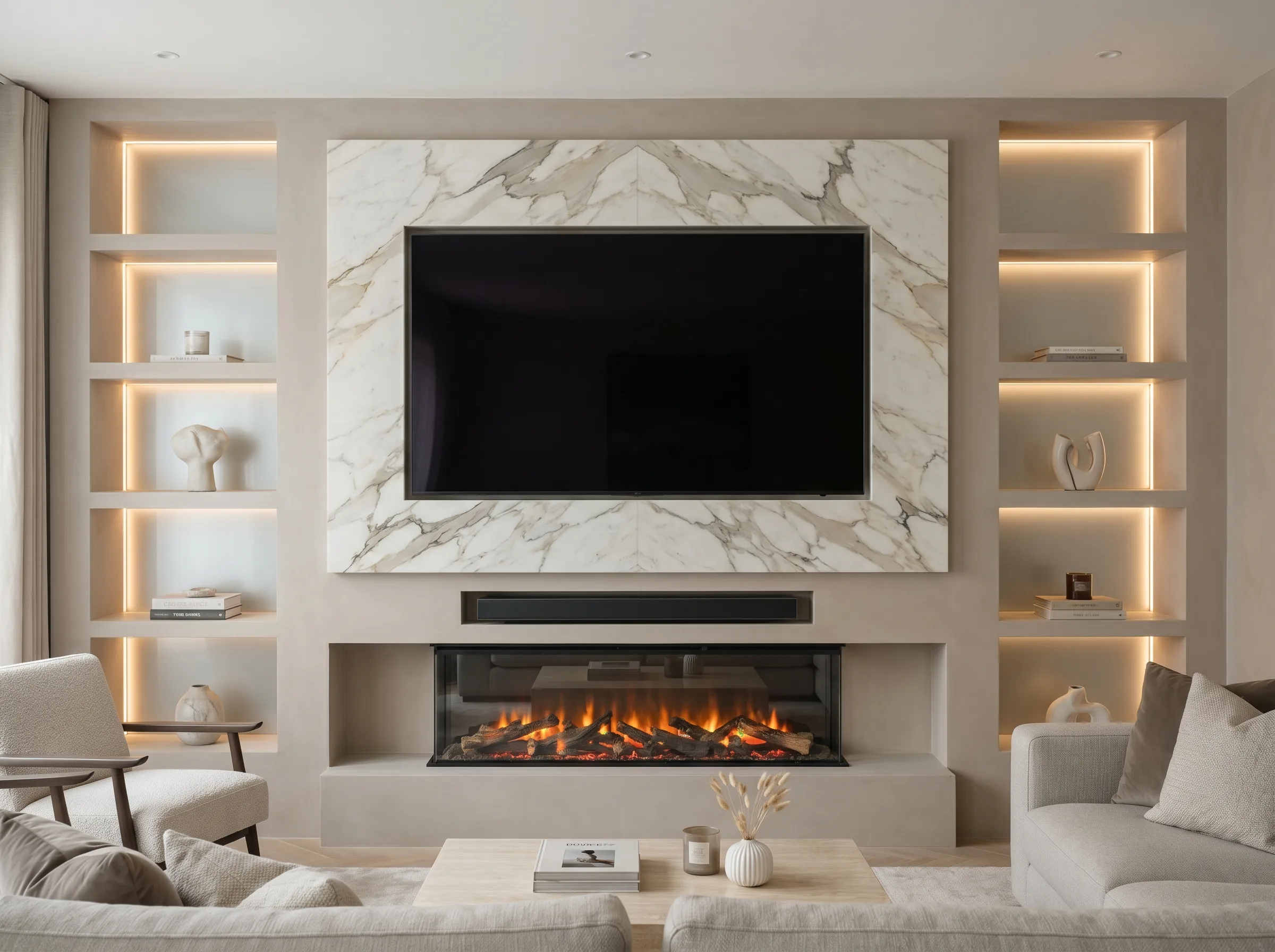
A client recently asked us for a pale lilac media wall with gold veins. That is quite a specific brief to take to a stone yard. With Venetian plaster, we can develop the colour and pattern for the room. The commission is still in progress, but it is a good example of why our clients consider plaster even when they love the look of marble.
Both finishes can suit a high-end interior. Natural marble has its own mineral variation, and choosing a particular slab can be part of the pleasure. Venetian plaster gives us more control over the finished design and avoids the handling involved with large pieces of stone. The right choice depends on what you want from the wall.
What is a Venetian plaster media wall?
A Venetian plaster media wall is finished with a hand-applied decorative plaster system that can recreate the depth, movement and veining associated with polished marble. It is available in a wide range of shades and can be developed with soft tonal variation or much stronger veins.
The finish is not natural marble and does not share all of marble's physical properties. Its advantage is flexibility. We can apply it behind the television, across the main feature panel, around selected shelves or onto a properly prepared piece of bespoke furniture.
We normally use it selectively. Covering every available surface can make the room feel busy. A polished centre panel paired with quieter cabinetry gives the finish enough space to be noticed without forcing every other material to compete with it.
What Venetian plaster is made from
Traditional lime-based Venetian plaster commonly combines slaked lime putty, finely ground marble and water. The lime binds the mixture, the marble contributes to its body and texture, and pigments provide the colour. Small amounts of additives help the applicator work the material. It is a specialist decorative coating, not ordinary wall plaster with a marble pattern painted over it.
There is no single recipe for everything sold as Venetian plaster. Modern systems can include polymer binders, and some use an acrylic binder instead of lime. For example, Stucco Italiano lists lime putty and powdered marble in Marmorino Fine, while San Marco specifies an acrylic binder for Stucco Veneziano. These are examples of different formulations, not a product specification for every LV project.
The chosen system determines how it is prepared, applied and protected. A gold or copper effect also needs compatible decorative materials. We develop those details through samples rather than treating any colour or resin as interchangeable.
Venetian plaster or marble: what changes the cost?
Venetian plaster can be a more affordable way to achieve a marble-inspired wall. The saving often comes from avoiding the purchase, fabrication and handling of large stone slabs. It is not a fixed percentage: an elaborate hand-created finish takes skilled labour, and a small, straightforward marble panel is a different proposition from a full wall of carefully matched stone.
Marble costs depend on the stone, usable slab sizes, cutting, edge details, transport and installation. Large slabs may need specialist lifting equipment, and access through the property matters. If the design calls for matched veining, the selection and layout of the slabs add another stage to the work.
Plaster is applied to a prepared surface on site, so there is no large slab to move into position. Preparation, sample development and drying still belong in the price and programme. Compare the same area with the same surrounding work included. A price for the decorative finish alone is not the price of a complete media wall. Our media wall cost guide breaks down three completed builds and the choices that changed their prices.
| Decision | Natural marble | Venetian plaster |
|---|---|---|
| Pattern | Selected from available slabs | Developed by hand on the wall |
| Joints | Depends on slab size, layout and fabrication | No slab joints on an uninterrupted panel; movement joints still matter |
| Weight | Heavy and may require lifting equipment | Applied in thin layers to a prepared substrate |
| Colour | Limited to available natural stone | Mixed and sampled for the room |
| Material | Unique natural stone | Decorative plaster with a marble-inspired finish |
| Cost | Stone, fabrication, access and installation | Preparation, samples, application and finishing |
| Care | Stone-specific cleaning and protection | Care depends on the plaster system and any protective finish |
Choosing slabs or developing a sample
When a client wants natural marble, we need to look beyond the name of the stone. Two slabs of the same variety can have different markings. A visit to a stone yard can help the client approve the exact pieces, although suppliers may also offer slab photographs or other ways to review them.
For our Venetian plaster work, the conversation happens around physical samples. We can develop the background shade and veining for the room without asking the client to find a matching set of slabs. That can save time spent sourcing stone, especially when the requested combination is unusual.
It does not remove the need to choose carefully. We want the client to see the dry sample in the room, against the cabinetry and under the intended lighting. That is a much better basis for approval than a colour on a phone screen. For help pairing plaster with timber, paint and metal details, see our media wall colour ideas.
A large panel without stone-slab joints
Imagine a feature panel 2.4 metres high and four metres wide. On a suitably prepared, uninterrupted surface, Venetian plaster lets us work across that whole area without dividing the finish into stone slabs. The veining can flow around the television and continue across the composition without a slab seam interrupting it.
That does not mean the wall underneath is one piece or that every construction joint can be covered. Required movement joints and maintenance access still need to be respected. We plan the framework and panel layout before discussing an uninterrupted decorative surface.
Marble does not always need multiple slabs, and a well-planned stone joint need not spoil the design. Bookmatching creates a mirrored pattern between adjoining slabs; vein matching aims to carry the pattern across them. The Natural Stone Institute's guide to bookmatching explains the distinction. Some clients love that symmetry. Others prefer the continuous, less constrained pattern we can create with plaster.
How we develop a custom colour
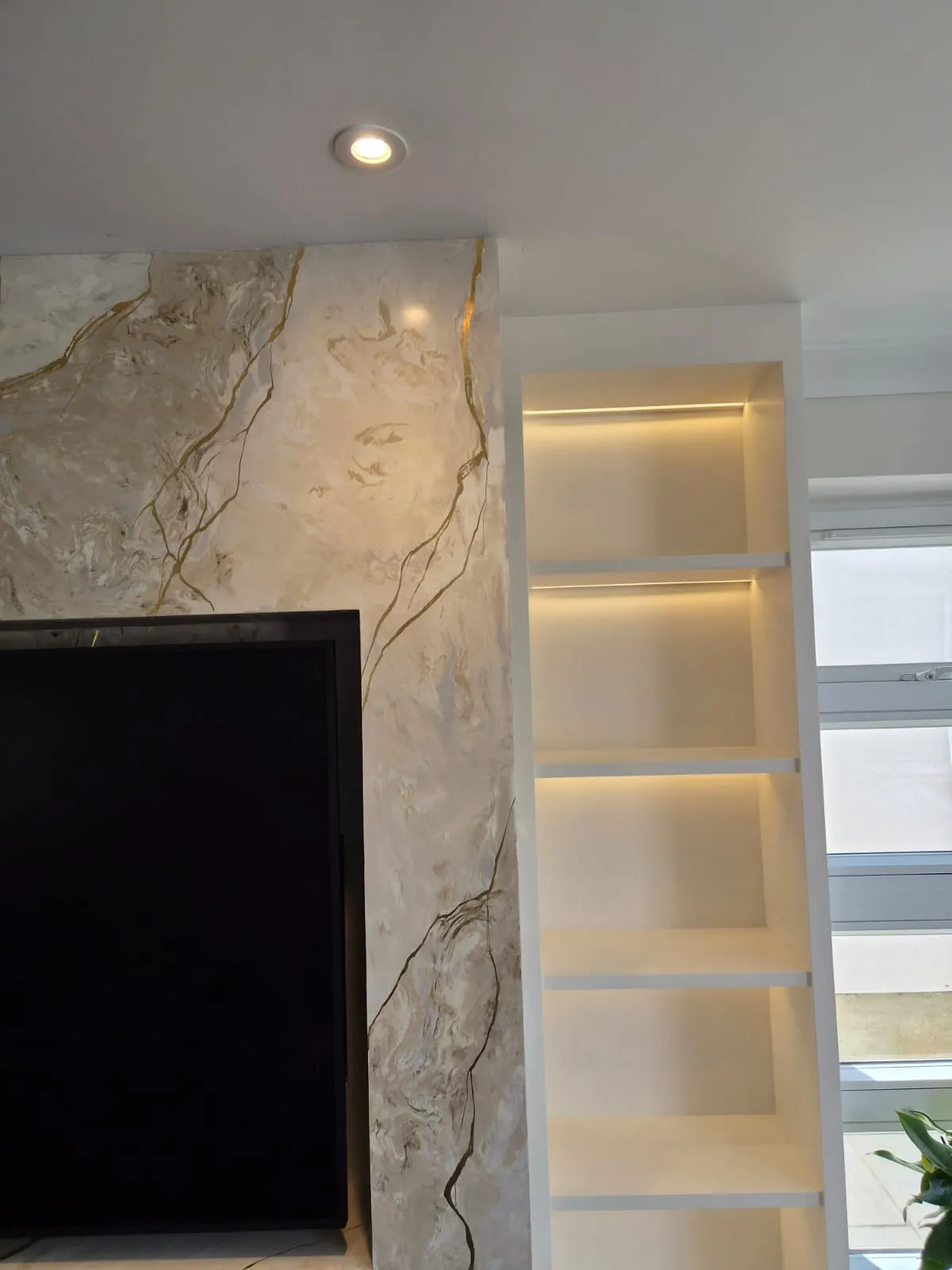
You might like tobacco-toned marble but want silver or soft grey veins instead of the markings in the slab you have seen. We can explore that combination in a decorative finish. Ivory accents, gold detailing or a copper effect offer other directions, depending on the chosen system.
We work through the background colour, how much movement it needs and the strength of the veins. A quiet wall behind detailed shelving needs a different treatment from a broad panel intended to be the main feature. We let the samples dry before judging them, because the wet mixture does not show the final colour or sheen.
I like being able to separate those decisions. A client can want the warmth of one reference and the finer veining of another. We do not have to ask them to accept the whole pattern of a particular slab.
On site: pale lilac with gold veins
For a current media-wall commission, the client asked for a light purple, almost lilac background with gold veining. We are developing the plaster finish around that request. It is a combination they wanted for their own room, rather than the closest match in a stone collection.
At the time of this September 2026 update, the job is still in progress. It is not presented here as a completed installation, and the photographs in this article show other finishes. The useful part of the story is the brief itself: a precise colour and vein combination that we can work towards through samples and hand application.

The main drawback is drying time
The main programme issue we encounter is drying time. Temperature, humidity, ventilation and the position of the room within the house all affect how quickly each stage cures.
The substrate has to be stable, dry and prepared for the specified system. Fresh plaster or repairs may need time before the decorative work can start. Once application begins, the product's instructions govern the intervals between coats and the finishing sequence.
Avoiding stone cutting and slab handling can simplify the job, but it does not guarantee a shorter programme. We allow for preparation and drying when we price the work. Rushing those stages to save a day is a poor trade for a finish you will look at every evening.
How we achieve the polished finish
The marble-inspired finishes we are discussing here have a polished sheen. The application and finishing method depends on the product system. Hand burnishing is part of many polished-plaster methods; where our selected system allows mechanical polishing, we work across the broad surface before attending to the smaller details.
Edges, corners and television recesses need particular attention. Integrated lighting makes a change in sheen easy to spot, so we check the finish with the lighting on. A good result in the middle of the panel is not enough if the returns look unfinished.
The result can be convincingly marble-inspired, but it is still a decorative coating. We would not describe it as physically identical to a slab of natural stone.
Watching the veins develop by hand
Clients are often surprised by how plain the first stage looks. The character emerges gradually as the specialist builds tonal variation, movement and veins across the wall.
Working from the approved sample, we can discuss whether an accent needs softening or a vein should be more pronounced while the application stage allows it. Clients can see those decisions taking shape on the actual wall. That involvement is one of the parts they enjoy most.
We still agree the main direction before work starts. Once a layer has set, a change may mean reworking it. Watching the application is a chance to refine an agreed finish, not a promise that a completed wall can be redesigned without extra work.
Care and repairs: neither finish is maintenance-free
Natural marble needs suitable cleaning products. The Natural Stone Institute recommends neutral cleaners and warns against acidic products on marble. Follow the stone supplier's advice on protection and sealing rather than assuming every slab needs the same treatment.
Venetian plaster care depends on its formulation and any protective finish. We would not recommend a generic cleaner, wax or scrubbing method without checking the specified system. A damaged decorative surface needs assessment too: matching the background colour is only part of a repair when the veining and sheen also have to blend in.
When I would choose marble, and when I would choose plaster
If you have found a slab you love and want genuine natural stone in the room, that is a good reason to choose marble. Its mineral variation is the attraction. We would plan the joints, support and installation around that material rather than try to talk you out of it.
I would lean towards Venetian plaster when the brief calls for a particular colour combination, a broad continuous panel or veining that we can develop around the room. The lower handling weight and potential saving are useful, but the ability to create the finish with the client is often what settles the decision.
Why one team matters
A decorative finish cannot compensate for a media wall that has been planned badly underneath. Power supplies, the television bracket, ventilation, Sky box storage, concealed cabling and maintenance access all need resolving before the final surface is applied.
We coordinate the carpentry, electrical work and Venetian plaster as one project. That prevents a socket being moved after the framework is complete or an access panel being discovered only after the wall has been polished. It also means the plaster specialist knows where every joint, edge and return has been formed.
Our bespoke media walls start from £7,000. The cost of a Venetian plaster finish depends on its area, preparation, colour development and level of detail. For broader material combinations, see our guide to media walls with panelling, or review the full media wall service and pricing.
Discuss Your FinishCommon questions
It is a media wall finished with a hand-applied decorative plaster system. The applicator builds colour, movement and veining in thin layers, then burnishes and polishes the surface to produce a marble-inspired finish.
It can be, particularly when the marble alternative needs large slabs, specialist fabrication and lifting. The difference depends on the stone, wall preparation, finish area and complexity of the hand-applied pattern. Compare quotations for the same finished area and scope, not the price of a slab against a complete plaster installation.
It can create a highly convincing marble-inspired appearance, but it is not natural stone and should not be sold as physically identical. Marble has natural mineral depth and variation. Venetian plaster offers greater control over colour, veining, continuity and weight.
The programme depends on the product system, substrate, temperature, humidity and ventilation. Preparation, drying between coats and final finishing all need time. Avoiding stone fabrication does not mean the plaster can be rushed. We confirm the sequence for the actual room.
Yes. We mix and dry several physical samples, present them in the client's room and record the approved colour so it can be reproduced consistently. Veining, sheen and tonal movement can also be adjusted around the design.
Traditional lime-based formulations commonly contain slaked lime putty, finely ground marble, water and small amounts of additives, with pigments used for colour. Modern decorative systems vary: some include polymer binders and others are acrylic-based. The exact composition depends on the specified product, so plaster and resin is not a universal recipe.
It can form a continuous decorative surface without stone-slab joints across a properly prepared, uninterrupted panel. The wall still needs appropriate construction underneath. Required movement joints and maintenance access must remain, so seamless does not mean bridging every joint or sealing equipment into the wall.
We agree the main colour and effect through samples first. You can see the finish developing on site and discuss adjustments while the application stage allows. A change after a layer has set may require reworking, so it is not an unlimited opportunity to redesign a finished surface.